Introduction to Lighting
Foreword
Introduction
Properties of Light
-Hard Light/Soft Light
Colour Temperature
-White Balance
Film Lights
-Redheads & Blondes
-HMIs & Halogens
Three Point Lighting
Intermediate concepts
-Natural Light, Bouncing
-Outdoors, Sharing
-Shadows, Depth
Appendix: Depth Perception
-Binocular Cues
-Monocular Cues
--Relative Size, Interposition
--Clarity, Motion, Light & Shadow
--Texture Gradient, Linear Perspective
About Phillips Mcintosh
Film Lights
Here are some of the more traditional options for lighting in the Film and TV industry. LED lighting technology is entering the market as an option that is more energy efficient, allows for variable colour temperatures and is more resilient to mishandling. LED lighting units vary with manufacturer and model but the principles are the same.
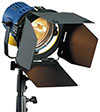
Red Head is a generic term to describe a range of lights that share two main qualities:
1. They can adjust between spot and flood
2. They typically use an 800W tungsten halogen globe
The example pictured here is an Arrilite 800w open-face focusing tungsten floodlight. The beam is focused using the yellow control at the back — this adjusts the reflector rather than the lamp, which should give the lamp a longer life because it is not being moved.

Blondes are typically bigger, brighter redheads. Power rating can be 1000 to 2000 watts, although the term generally refers to a 2000w open-face unit.
Copyright 2012-13. All rights reserved